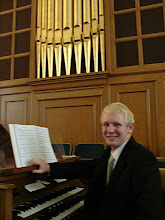
Well, I have now officially performed on the Tabernacle Organ in Salt Lake City, and what an incredible experience it was, too. My co-workers and I met up at the Cannon Center around 11:00 and, after a short delay because I had accidentally thrown my car keys into the trash can, we left soon thereafter and arrived in Salt Lake around 12:15. Richard Elliott’s organ recital began at noon and I had wanted to be there for it (and I certainly didn’t want to miss the opportunity to play the organ), so after frantically finding a parking spot near the conference center, I sprinted the three blocks to Temple Square and then ran on to the Tabernacle. I arrived around 12:20 and found the doors locked, but the sister missionaries allowed me to enter a side room, where I was able to watch Dr. Elliott’s last (and very impressive) organ piece through a glass window, so as not to disturb the audience. Sitting with me in the room where two older women and after Dr. Elliott’s last piece, one of them looked at me and said, “Do you play the organ, young man?” I was a little bit surprised, but I replied that I did. “I could tell by the way that you were watching him,” she responded, referring to Dr. Elliott. I wish that had stayed to chat with those two women a little bit more, but I was too excited and in a hurry to meet Brother Elliott, so I excused myself and hurried onto the main plaza of the Tabernacle.
I made my way to the front of the pews, where Dr. Elliott was talking with some of the audience members. I sat on one of the benches and began putting on my shoes. My friends and parents came up to join me and I was soon bombarded with questions as to whether I was nervous, if I was excited, etc. I was nervous, but not nearly as much as I thought I would be. I was, however, extremely excited. This was one of my biggest dreams, and as I stared up at the gigantic instrument I couldn’t help but feel awed at the extremely rare experience I was about to have.
At this point, Dr. Elliott was finishing up his conversations with the audience members, so I moved over to stand nearby. He was talking with an older gentleman who had arrived late and who was expressing his disappointment at not being able to hear the magnificent organ. “Actually,” Dr. Elliott replied, motioning to me, “this young man is going to be playing it for a little bit.” The man’s face lit up. “Oh wonderful,” he said, and then he turned to go find a seat. My nervousness had increased a bit by this point, but so had my excitement. I shook Dr. Elliott’s hand and thanked him for allowing me to have this opportunity. “Not a problem,” he said. Then he proceeded to direct me towards the stand. We advanced passed the velvet “movie theater” rope and it occurred that very few of the general public is allowed to pass that point. As we made our way up the stairs towards the organ console, Dr. Elliott began talking about how the organ was slightly out of tune, as if we were old friends and colleagues; he almost seemed as excited as I was. We crossed the platform and reached the organ console. It was even more impressive up close and in person. Everything was beautifully designed, even down to the organ bench, which curved in elegant bows. There were more volume control pedals than I had ever seen before, and surprisingly there were a few high-tech looking screens. And don’t even get me started on the stops; there were so many and I felt slightly overwhelmed by the variety of tones.
“I’ve never played on anything like this before,” I said to Dr. Elliott. “I’ve only played on a little chapel organ.”
“Why don’t you put your music on the stand and get the bench adjusted while I get the stops ready for you,” he replied.
I pulled out my first song, a powerful arrangement of “Come, Come Ye Saints” by Clay Christiansen (for which I have been preparing for this very occasion), adjusted the bench just slightly, and sat down. Dr. Elliott glanced at my music, pulled a few stops, and showed me which of the five manuals were the great and the swell (which were actually the second and the third manuals, not the bottom one like I was used to). “Okay, whenever you’re ready,” he said. I put my hands and feet in position and began to play.
The first thing I noticed was that the keys were made out of wood (maybe pine?), not the usual plastic keys that I was used to on chapel organs. After that, I became focused on the music; I forgot about the audience, I barely noticed Dr. Elliott as he moved around changing the stops; I even failed to think about on which organ I was playing. My life had become dedicated to conveying the message of that powerful hymn. I thought of the pioneers who had crossed the plains, especially my own ancestors; it was because of them that I was playing that piece. It was dedicated to them; in fact, I had prayed to God earlier that day that my ancestors would be able to hear me play. Dr. Elliott selected very fitting arrangements of stops, conveying feelings of hope, joy, and faith, corresponding with the words of the verse I was playing. Soon the organ rumbled the last chorus of the hymn, “All is well, all is well,” and I added my own improvisation at the end. I let the organ thunder the last chord for a few seconds, basking in the power of the pioneer-built instrument. Then I released the keys and heard the reverberation of the last notes as they echoed around the acoustically unique Tabernacle. There was a slight pause, and then I heard enthusiastic applause. I looked down at the pews and was surprised to see a fairly large audience. I’m sure that I had a huge smile on my face and I was eager for more. I asked Dr. Elliot how much time I had, to which he replied that I had around ten more minutes.
I pulled out my hymnbook, the next piece I would play already planned out in my head. I opened to page two, “The Spirit of God,” and Dr. Elliott began setting the stops. The organ thundered and I thought of the dedication of the Kirtland temple: “And help us by the power of thy Spirit, that we may mingle our voices with those bright, shining seraphs around thy throne, with acclamations of praise, singing Hosanna to God and the Lamb!” (D&C 109:79). What a powerful hymn of praise! In my mind, there isn’t a hymn that expresses greater admiration and glory to God the Father and His Son. “How blessed the day when the lamb and the lion shall lie down together… as Jesus descends with His chariot of fire!”
As the echoes of the last chord of “The Spirit of God,” died out, Dr. Elliott turned to me and said, “Why don’t you pick a softer song now. Then I can show you some of the more beautiful strings and flutes that the Organ produces.” I flipped through the hymnbook and came across “Abide With Me; ‘Tis Eventide.” Perfect, I thought. The different tones that that organ is able to produce are completely amazing; it went from powerful trumpeter to gentle comforter with just a few switches of stops. This song has always brought peace to my heart and as I played I tried to convey the pleading desire: “Oh Savior, stay this night with me; behold, ‘tis eventide.”
The next song truly showed the contrasting ability that the Organ has. I decided to play “Lord, I Would Follow Thee,” dedicating it to a dear friend of mine. Dr. Elliott truly worked his magic on this song, the sound volume swelling slightly in the middle before decrescendoing to nothing more than a low rumble with the last professing statement of “Lord, I would follow Thee.” I held the chord longer than I normally would have; absorbing the deep, low resonance of the organ, my ears sorting through the different tones comprising the pianissimo chord.
As I lifted my fingers from keys, Dr. Elliott said, “Why don’t we open her up for the last song.” I turned to the audience and said, “What do you guys want to hear?” “Battle Hymn of the Republic!” “If You Could Hie to Kolob!” None of them sounded right though. I almost went with “The Battle Hymn of the Republic,” but then another hymn popped into my head. I turned the pages in the hymnbook to page 134, “I Believe in Christ,” one of my favorite hymns and the quintessential expression of my testimony of the Savior. Once more the organ boomed, this time professing my deep faith in Jesus Christ. I went all out with the pedals on the last first, my feet oftentimes flying in two different directions. I wanted all those within earshot of the Tabernacle to hear of my testimony of the Lord, Jesus Christ, “oh blessed name! With all my heart to Him I’ll sing! I’ll worship Him with all my might; He is the source of Truth and Light!” Dr. Elliot pulled out all of the stops for the last chord; my left foot pressed down on the second lowest note of the pedals while my right foot depressed the “A” above it, causing an even greater rumbling; my right hand played the last “D” chord an octave higher; the whole Tabernacle was alive with the sound of my testimony as the Organ proclaimed with trumpets the divinity of the Son of God.
Finally the last reverberations of the chord were absorbed, but still I sat on the bench, not wanting to leave but realizing that the time had come. I picked up my music books and slid off the bench. As we walked across the stage, Richard Elliott asked me if I was attending classes or just working for the summer. I told him that I was just working. He then asked if I had a job working in the dorms, which astounded me because I had only briefly mentioned to him many months before in January that I worked for BYU housing. (I’m sure that it helped that my “signature” for the many emails I sent him designated me as the “President” of the “Residence Halls Association.” We chatted as we walked and still he amazed me; “So which high school does your younger brother attend? He goes to Box Elder, right?”
“Uh, yeah.”
“Did you go there too? They have a phenomenal choir.”
“Yep, we sure do. Nationally renowned.”
We chatted a bit about the high school choir teacher, Claudia Bigler, who had just retired from the Mormon Tabernacle Choir. Before I knew it, we had walked through those velvet ropes and were back in the realm of the audience. My parents embraced me and told me how extremely proud they were of me, and then they turned to thank Dr. Elliott. My co-workers then surrounded me, and my friend, Annette, presented me with a chocolate bouquet that they had made. Many of them shared experiences they had when the music had touched them deeply, which made my performance that much more special. Dr. Elliott said goodbye and disappeared back up to the organ. We posed for some pictures and slowly moseyed our way back to our cars.
So one may ask what I was feeling as I was playing the Organ. To be honest, playing that organ didn’t feel any different than playing any other organ that I had played on; I didn’t feel intimidated at all by the skill of Dr. Elliott; in fact, I wasn’t nervous at all. It was just me and the Organ. I guess I had many tourists take video and pictures of me, and I still find it slightly strange that I’m going to end up in someone’s travel log. But it was truly an incredible experience, playing as world famous and historic organ as the one in the Salt Lake Tabernacle. No other instrument compares to the amount of sacrifice that went into its construction. It was only made possible because of the Lord; He provided me with the talent; He provided me with a way to contact Dr. Elliott; He provided me with the determination and the guts to keep persisting and to never give up; He provided me with transportation (thanks to the Howard family, who presented me with their extra car the day before I found out about my performance); He blessed me with supportive family and friends; it is only because of Him that I had this opportunity and I am still amazed with how smoothly everything fell into place. I know that it all came from Him and for that I am very grateful.